
Missouri DOC Releases for Howard County Cases
No adult Missouri DOC prison was verified within Howard County. A person sentenced from a Howard County case may first leave the local jail as a transfer to state custody, then move between institutions under statewide assignment. The county transfer is not a community release. The state record becomes the right source after MODOC receives the person.
Later, physical departure from a state institution may lead to parole or conditional release in the community. MODOC legal custody and field supervision can continue. Final discharge occurs only after the sentence and supervision end. These milestones can have different dates and different records.
Howard County Jail custody ends, but state imprisonment begins or continues.
The person leaves an institution and may enter MODOC field supervision.
The sentence and MODOC supervision have ended.
Confirm a Missouri DOC Release
Choose the route by present status. The MODOC Offender Web Search is the first official check for a person who may still be incarcerated, on probation, or on parole. Its landing page expressly says discharged offenders are not provided. An active field-supervision result can establish that the person is outside prison while still under state control.
- Search the active portal by first and last name and consider aliases.
- Match identity and DOC information rather than relying on a name alone.
- Read whether the result reflects an institution or active field supervision.
- If no result appears, check the MODOC nightly Sunshine file for a completed sentence and date fields.
- Request the individualized release or discharge record when an exact event or official explanation is needed.
- Use MOVANS or the assigned officer for a current supervision event, then verify the final fact with MODOC.
No active-search result does not prove that a person was never in MODOC or that a particular release date occurred.
Missouri DOC Discharge Records in Sunshine Data
Missouri provides a useful nightly historical offender file through the MODOC Sunshine Law page. It includes people who are or have been under supervision and can reach back to 1974. The file works as a historical starting point after a finally discharged person has disappeared from the interactive portal.
| Field | How to read it |
|---|---|
| DOC number and identity | Connects charge-level rows to the same person. |
$FOI | Distinguishes field supervision from an institution. |
$OLA | Shows the assigned place in the data. |
$SCF | A completed value of Y identifies a completed sentence row. |
$PC | Provides calculated minimum-release context. |
$PD | Provides maximum release or expiration context. |
| Cause, county, charge, and sentence | Connects the correctional row to the underlying case. |
The file is charge-level, so one person can have multiple rows with different dates. MODOC also warns about accuracy limits. Do not reduce the first matching row to a final-release claim. Reconcile the completed flag, field or institution value, dates, cause number, and an individualized agency response.
The official Sunshine page shown in the site image explains why the nightly file is the historical route after final discharge.
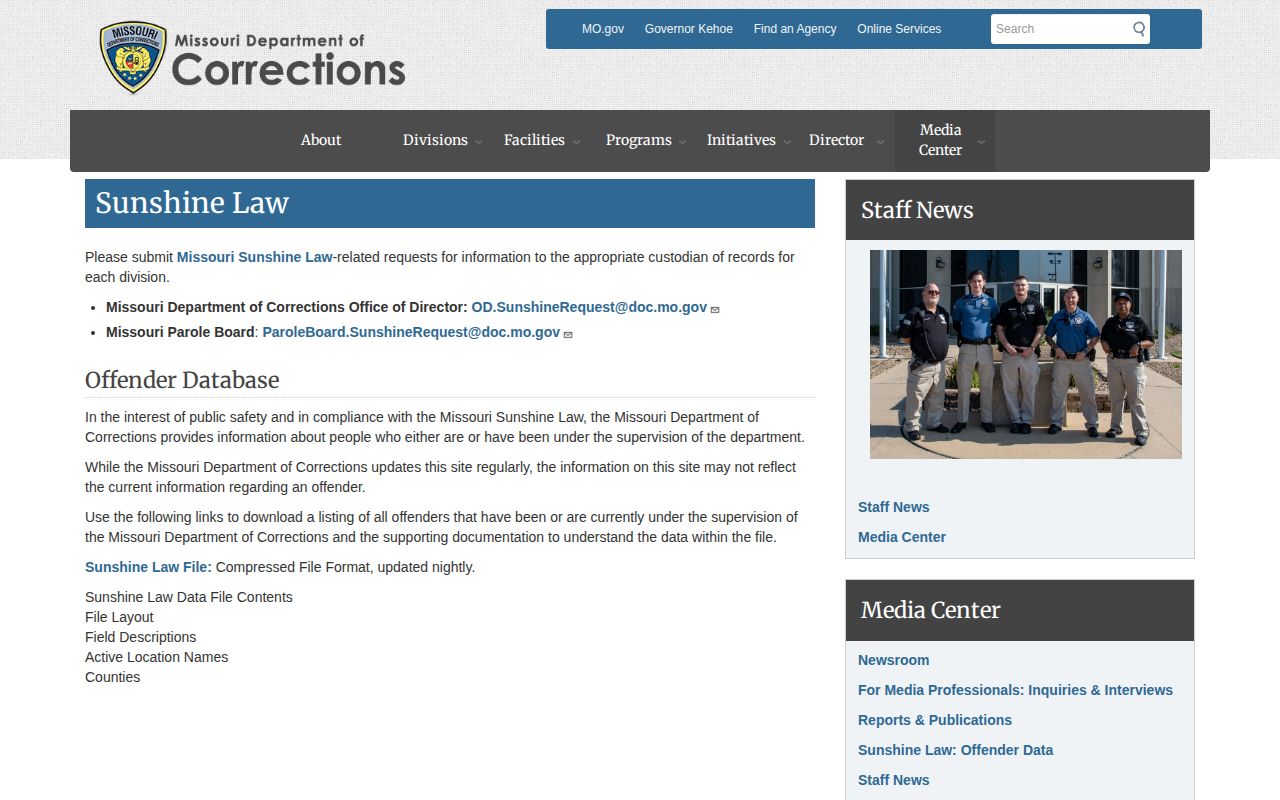
The image supports the data-access route; it does not replace record-by-record interpretation or an official discharge response.
Missouri DOC Release Dates Are Different
A minimum date, presumptive parole date, conditional-release date, maximum expiration date, physical prison exit, and final discharge are distinct. A projected date can change because of a court correction, concurrent or consecutive sentences, a statutory minimum, Parole Board action, an institutional violation, a program requirement, a detainer, a new case, or corrected data.
Missouri § 558.011 divides eligible felony terms into prison and conditional-release portions. Conditional release is supervised and conditional rather than final sentence completion. § 558.019 imposes minimum-prison-term rules for specified histories and offenses. Its 85-percent rule applies to dangerous felonies as defined by law, not to every Missouri prisoner.
Earned compliance credits under § 217.703 concern eligible people already on probation, parole, or conditional release. They can affect final supervision discharge. They are not a universal source of prison good time. The institution's caseworker, parole office, or assigned field officer should answer case-specific date questions.
Parole After a Missouri DOC Release
The Missouri Parole Board can set a future release date or schedule another hearing, but a hearing is not a promise of release. Its official process says decisions usually take about eight to twelve weeks. No official public calendar of individual hearing dates or searchable public results database was found. A Board order, MOVANS notification, institutional parole office, or assigned officer supplies the case-specific result.
Parole is discretionary and leaves the person in MODOC legal custody. Conditional release also continues supervision. The active offender portal includes parolees and probationers, which makes an active field result useful after prison release. When the term finally ends, the interactive portal removes the discharged person.
The Howard County post-release supervision guide explains the narrow registry cross-check, District 6 Columbia lead, and the difference between parole and probation.
Request Missouri DOC Release Records
Use an individualized request when the nightly file is ambiguous or when the exact physical release, conditional release, parole, expiration, or final discharge event matters. Identify the person, DOC number if known, cause number, Howard County sentence, and the approximate period. State which event is being requested so “release” is not left undefined.
MODOC Office of Director Sunshine Requests
Email: OD.SunshineRequest@doc.mo.gov
Ask for the releasable individualized release or discharge record and the meaning of any status codes.
For a Parole Board order, use ParoleBoard.SunshineRequest@doc.mo.gov. The Board's general contact is 3400 Knipp Drive, Jefferson City, MO 65109, phone 573-751-8488, and fax 573-751-8501. No flat MODOC release-record fee was verified. Ask for an itemized estimate under Missouri's public-record fee rule before work begins.
Link a Howard County Transfer to MODOC
Start with the Howard County sheriff event when the person was last known at the local jail. Official source material identifies Jeff Oswald as sheriff. Ask his office whether the record names MODOC as the receiving agency and note the transfer time. Then use Case.net to identify the Howard County judgment and sentence. Those two sources explain why the local custody view ended and why the state search became relevant.
After transfer, the Howard County Circuit Clerk can provide a public judgment or sentence that is not remotely accessible, but it does not control MODOC placement or certify a later prison exit. Likewise, the sheriff cannot supply the final state discharge record. Each agency should be used for the event it created.
The main Howard County released-inmate records page lays out the full county-to-state search path and the record fields to preserve at each step.
Missouri DOC Records Do Not Cover Federal Custody
MODOC records do not establish an ordinary federal or immigration release. If a Howard County record names BOP, the U.S. Marshals Service, or ICE, change systems. BOP's locator can show “Released” or “Not in BOP Custody” for a sentenced federal prisoner. ICE's locator concerns current ICE custody, and an empty result is not release proof. Marshal history may require the federal docket or a USMS record request.
The USMS Prisoner Tracking System page pictured below documents the federal record layer that is separate from Missouri DOC.
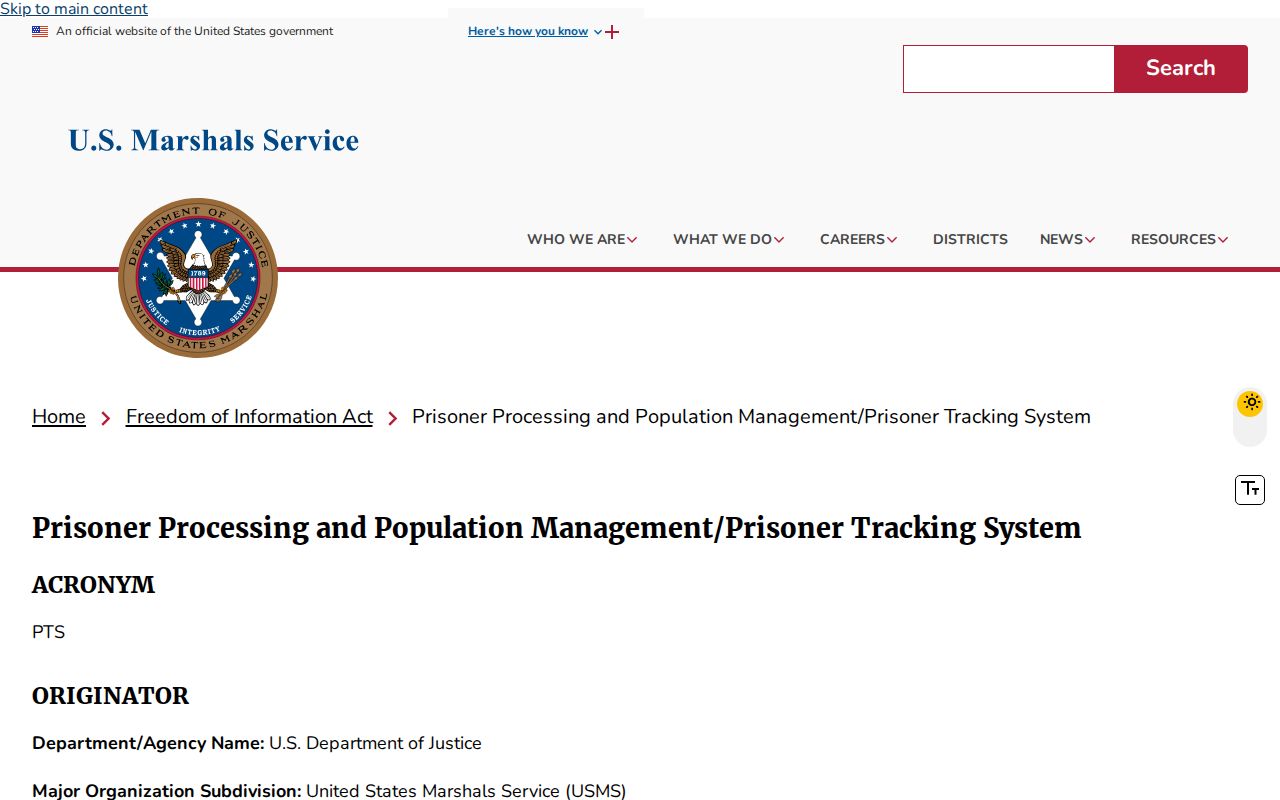
The federal tracking description is a jurisdiction check, not a public name locator and not proof that Howard County Jail holds federal detainees.
About Missouri Department of Corrections Records
This page represents the statewide correctional system that may receive a sentenced Howard County defendant. It is not a claim that a Missouri DOC prison stands in Howard County. No adult state institution was verified in the county, and a nearby institution is not the presumed destination. Placement and transfer can occur across the state system.
MODOC's active search, historical Sunshine file, records office, Parole Board, and field officer each answer a different part of the release question. The active portal handles current imprisonment and supervision. Historical data and formal requests address completed sentences. The Board or officer supplies individualized parole and supervision detail. A careful release search keeps those roles separate.
A Howard County prosecution may also produce more than one cause or charge-level row. Match the cause number, sentence county, charge, completed flag, and date fields before treating a Sunshine entry as the final state record for that person.
Note: A field-supervision result supports community placement under state control, while a completed Sunshine row needs charge-level reconciliation before reporting final discharge.